
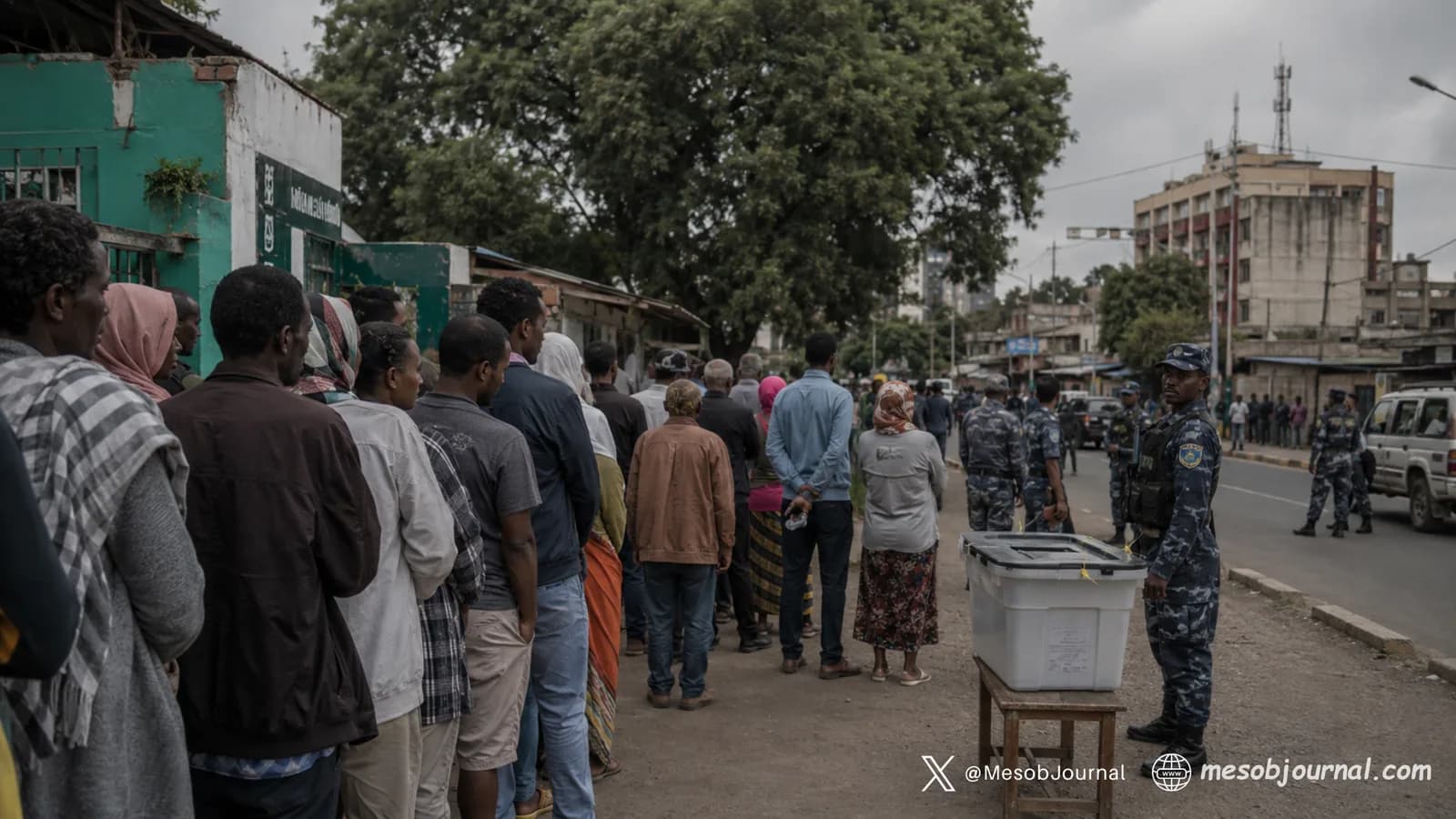
For almost seventy years, from the reign of Emperor Haile Selassie to the present day, Ethiopia has lived under a political tradition in which elections function less as instruments of public choice and more as rituals of state continuity.
The introduction of ethnic federalism in 1995 and the six general elections that followed did not alter this fundamental reality; the ruling party has won every time, and the country has never experienced a peaceful transfer of power.
As Ethiopia approaches the June 2026 general election, the pattern not only persists but deepens, revealing a political system that has mastered the choreography of democratic performance while hollowing out its substance.
Colonel Abiy Ahmed Ali, once celebrated as a reformer and Nobel Peace Prize laureate, now presides over a nation fractured by insurgencies, regional tensions, and a widening gulf between official narratives and lived realities.
His Prosperity Party, the successor to the EPRDF, prepares for an election that is less a contest than a coronation, even as the state’s territorial control shrinks and its legitimacy erodes.
The National Electoral Board of Ethiopia (NEBE) presents impressive statistics: forty-seven registered parties, nearly eleven thousand candidates, millions of voters, as if quantity alone could substitute for credibility.
Yet these numbers conceal more than they reveal. Most parties are aligned with the ruling party, while genuine opposition groups such as the TPLF, OLF, OFC, and ONLF face harassment, arbitrary arrests, bureaucratic obstruction, and targeted violence.
Their officials navigate a maze of licensing hurdles and administrative sabotage designed to exhaust their resources and limit their reach.
Meanwhile, the NEBE approves token opposition parties that pose no threat to the ruling party’s dominance, creating the illusion of pluralism while ensuring that real alternatives remain structurally marginalized.
This strategy proved effective in 2021, when the Prosperity Party secured 96.8 percent of parliamentary seats, a result so lopsided that it exposed the system’s predetermination rather than its popularity.
The opposition now faces a painful dilemma: participate and legitimize a rigged process, or boycott and risk political extinction.
The OFC, once capable of fielding hundreds of candidates, now runs only ten, largely to avoid deregistration.
Opposition coalitions threaten withdrawal, citing intimidation, legal violations, and administrative irregularities, yet they remain divided not only over tactics but over the deeper constitutional questions that define Ethiopia’s political future.
The first-past-the-post electoral system compounds their weakness. In 2021, opposition parties won nearly a third of the vote in Addis Ababa yet received no seats, a stark demonstration of how the system converts minority rule into parliamentary dominance.
Gerrymandering, voter suppression, and the overwhelming resource advantage of incumbency complete the architecture of predetermination.
The security landscape further undermines the possibility of a national election. In Amhara, the Fano insurgency controls large rural territories and openly threatens anyone who participates in the electoral process.
In Oromia, the OLA expands its operations, exploiting the security vacuum created by the redeployment of federal troops to the north.
In Tigray, political alienation deepens as the region remains sidelined from national decision-making and caught between federal pressure and internal fragmentation.
The NEBE’s electoral map, which categorizes constituencies by security status, effectively acknowledges that vast areas of the country cannot vote.
Yet the Board refuses to address the implications of this exclusion, undermining any claim to national legitimacy.
Even if voting were technically possible, insurgent groups view the election as fraudulent and would actively discourage participation.
The NEBE itself has become a central actor in the political crisis.
Opposition parties accuse the Board of being co-opted by federal authorities, pointing to restrictive registration requirements that disenfranchise rural and displaced populations.
The decision to bar the TPLF from the 2026 election while licensing Getachew Reda’s Simret party aligned with federal interests signals a deliberate effort to reshape Tigray’s political landscape.
In the Somali Regional State, the dismantling of the legitimate ONLF and its replacement with a compliant faction further illustrates the Board’s role in engineering political outcomes.
Meanwhile, domestic monitoring groups face harassment, journalists are barred from conflict zones, and more than 1,500 civil society organizations have been shuttered or suspended.
International observers, who might expose these conditions, have been blocked or indefinitely delayed.
It is in this context that the government and its defenders deploy the argument that Western nations are hypocritical for insisting on observing African elections while allegedly refusing African observers on their own.
This narrative is politically convenient but fundamentally misleading.
Ethiopia did not reject Western observers out of principle; it rejected those who would expose the election’s illegitimacy.
African Union and IGAD observers were welcomed precisely because they pose less political risk and operate within diplomatic constraints that discourage direct confrontation.
Western elections do allow foreign observers, including African institutions, provided they meet accreditation standards.
The issue is not racial or geopolitical double standards but institutional capacity and neutrality.
The Ethiopian government’s rhetoric is therefore less a principled stand against hypocrisy than a strategic deflection from its own authoritarian practices.
A government confident in its legitimacy does not fear scrutiny; a government staging an election does.
The regional environment adds further volatility.
ENDF troop movements near Tigray, Eritrean military activity along the border, Sudan’s accusations of Ethiopian drone strikes, and the involvement of regional powers such as the UAE, Turkey, Israel, and Saudi Arabia create a combustible atmosphere.
Abiy’s ambitions for access to the Red Sea, constitutional restructuring, and centralized authority collide with a region already on edge.
The election does not stabilize Ethiopia; it accelerates its drift toward fragmentation and potential conflict.
At the heart of the 2026 election lies a constitutional endgame.
The Prosperity Party has long viewed the 1995 ethnic-federal constitution with suspicion, and Abiy’s philosophy of medemer hints at a shift toward greater centralization.
The National Dialogue Commission, stalled and symbolic, is expected to endorse revisions that weaken regional autonomy and consolidate executive power.
A decisive electoral victory regardless of how it is achieved provides the political mandate for these changes.
The election is therefore not merely a mechanism for retaining power but a prelude to structural transformation that could redefine Ethiopia’s political landscape for generations.
Yet even as the government prepares for a coronation, the limits of the state become increasingly visible.
Millions of Ethiopians live in areas where voting is impossible due to conflict or displacement.
Millions more will vote under conditions shaped by intimidation, restricted access, and administrative manipulation.
The ruling party will claim victory, and the international community will likely respond with cautious congratulations and muted concern.
But no amount of ceremony can disguise the reality of a state losing territorial control, a society splintering under pressure, and a political system that offers its citizens the form of democracy without its substance.
Ethiopia’s 2026 election is not a democratic moment.
It is a performance staged atop a fractured nation, a coronation in a collapsing palace, and a reminder that the machinery of legitimacy can continue to function long after the foundations of the state have begun to crumble.