
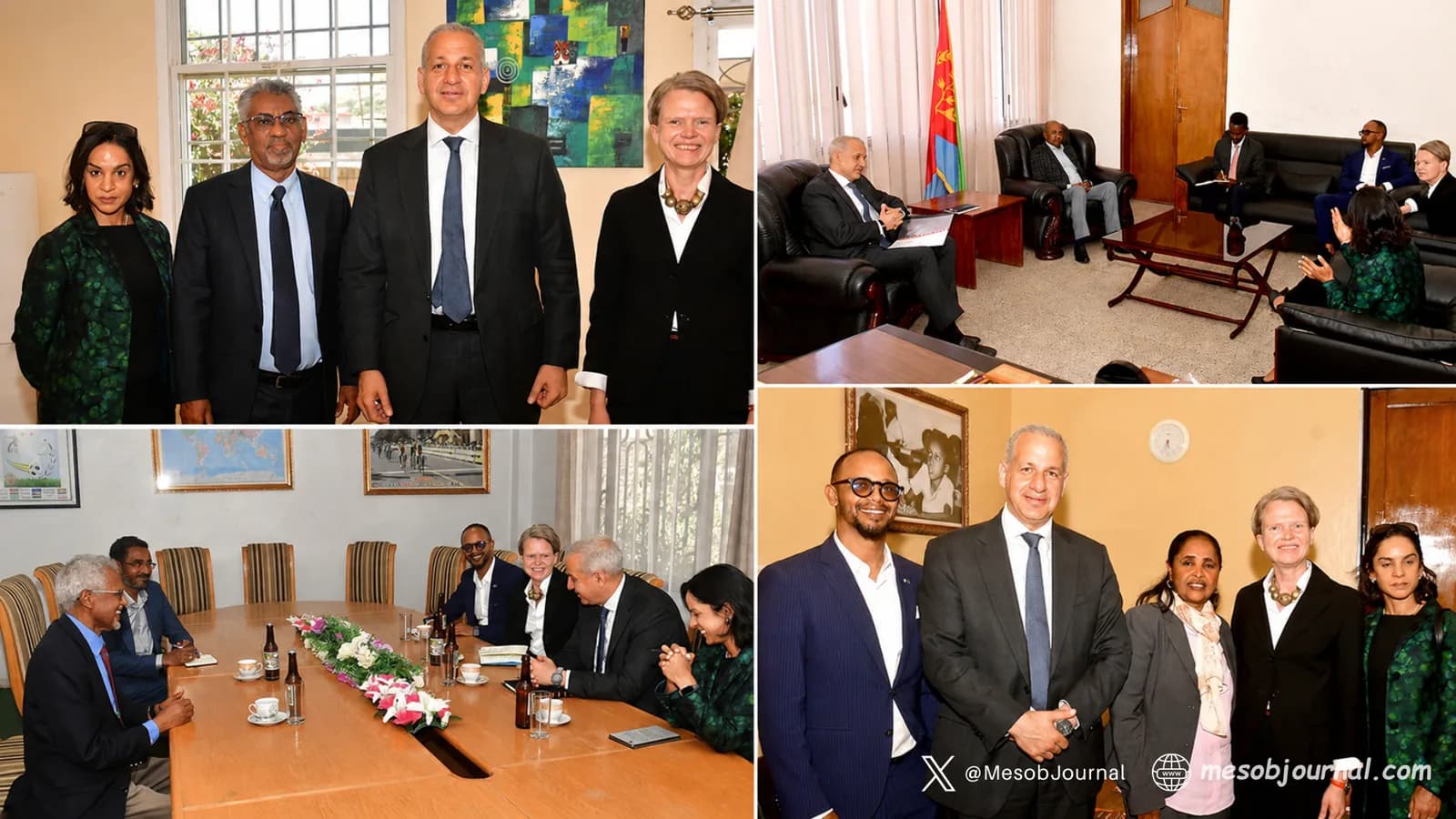
A UNESCO delegation held talks with senior Eritrean government officials in Asmara on May 28, focusing on cooperation in education, heritage documentation, digital science and the use of Artificial Intelligence in education and information, Eritrea’s Ministry of Information said.
The delegation was led by Mohamed El Faranawy, Acting Assistant Director-General of UNESCO, and included Louise Haxthausen, UNESCO Regional Director for East Africa. The officials met with Foreign Minister Osman Saleh, Information Minister Yemane Gebremeskel, Education Minister Dr. Halima Mohammed, and Ambassador Zemede Tekle, Commissioner of Culture and Sports.
According to the ministry, the discussions centred on expanding bilateral cooperation and areas of mutual interest. The talks covered education, documentation of Eritrea’s historical and intangible heritage, and experience-sharing in digital science and AI applications in the education and information sectors.
Nahla Valji, the United Nations Resident Coordinator in Eritrea, also took part in the meeting. The two sides reached consensus on developing and strengthening existing cooperation, the ministry said.
The visit comes against the backdrop of Eritrea’s established engagement with UNESCO in the field of cultural heritage. Eritrea currently has one property on the UNESCO World Heritage List: Asmara: A Modernist African City, inscribed in 2017 under criteria (ii) and (iv).
UNESCO describes Asmara as an exceptionally well-preserved planned city whose urban development took shape between 1893 and 1941, combining an orthogonal grid with later radial elements and reflecting an important chapter in early modern urbanism in an African setting. The listed property covers 481 hectares with a 1,203-hectare buffer zone.

UNESCO’s description also makes clear that the heritage value of Asmara goes beyond landmark buildings alone. The property includes not only the city’s modernist and rationalist architecture, but also the wider urban fabric, public spaces and the indigenous neighbourhoods of Arbate Asmera and Abbashawel.
UNESCO further notes that Asmara is among the most complete and intact collections of modernist architecture in the world, while Eritrea’s broader heritage engagement also includes the Qoahito Cultural Landscape on the country’s tentative list.
The latest discussions suggest that Eritrea and UNESCO are looking beyond preservation alone, with education, digitalisation and AI now included among the areas identified for possible cooperation. For Eritrea, the meeting also places heritage documentation within a broader institutional framework, linking culture, education and technology at a time when many countries are reassessing how digital tools can support public learning and national archives.
No further details were immediately announced on specific programmes, timelines or funding mechanisms. But the agreement to strengthen existing cooperation indicates that follow-up work between Eritrean institutions, UNESCO and the UN country team is expected.