
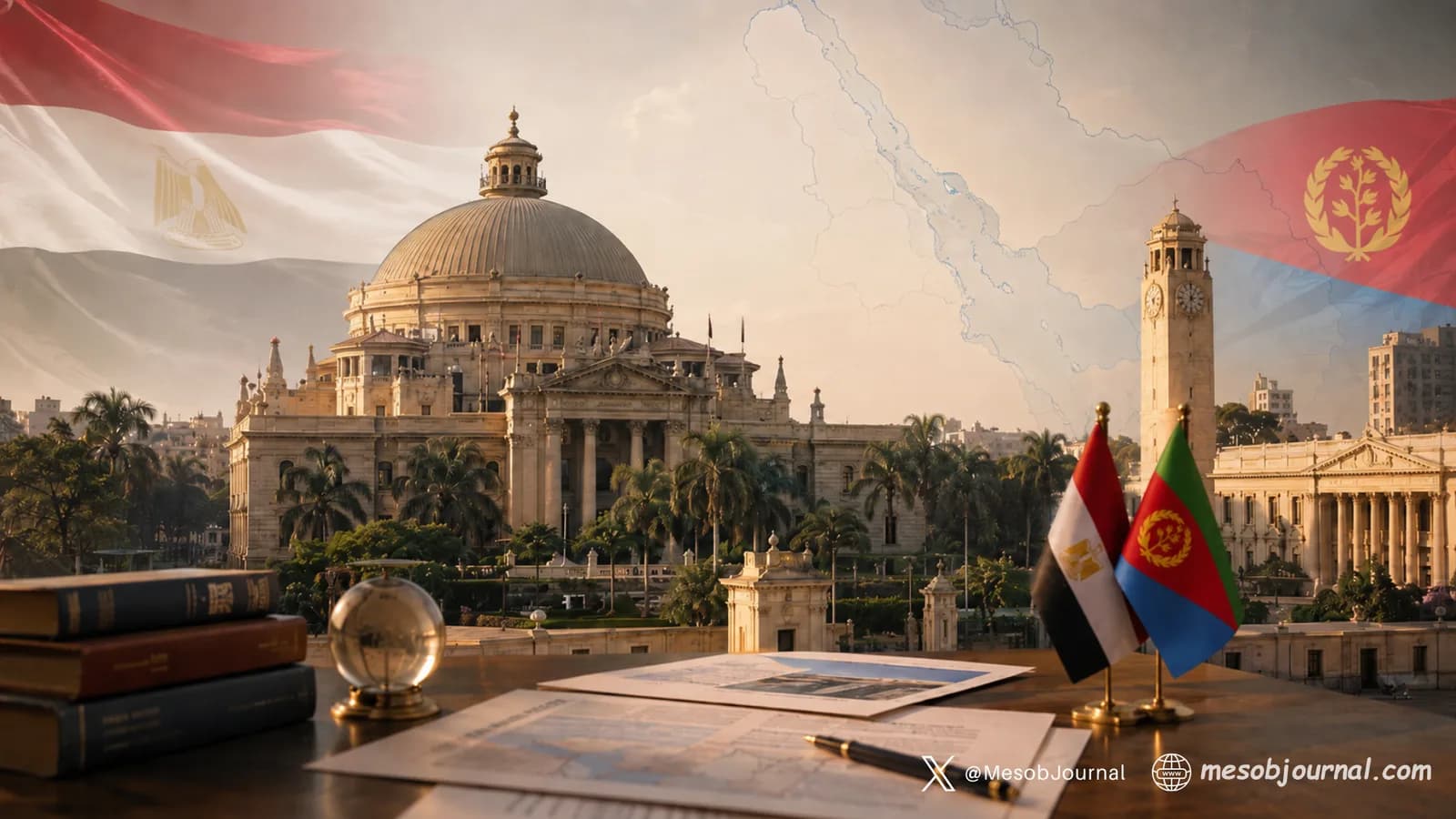
Egypt has approved the establishment of a Cairo University branch in Eritrea, adding an educational pillar to a fast-developing partnership between the two Red Sea states.
The decision was approved by Egypt’s Supreme Council of Universities during its regular meeting on Monday, according to Egyptian reports citing the Ministry of Higher Education and Scientific Research. The council approved the branch while instructing that the necessary legal procedures be completed.
The approval comes less than two weeks after Egypt and Eritrea signed a maritime transport cooperation agreement in Asmara during a visit by Egyptian Foreign Minister Badr Abdelatty and Transport Minister Kamel El-Wazir. That agreement, signed in the presence of President Isaias Afwerki, was presented by Cairo as a step toward stronger logistical connectivity, trade, investment and development cooperation between the two countries.
Seen together, the two moves point to a relationship that is no longer limited to diplomatic coordination or regional security language. Egypt and Eritrea are now building links in practical sectors: ports, shipping, transport, training, education and institutional capacity.
For Eritrea, a Cairo University branch could support higher education access, professional training and long-term academic exchange with one of Africa’s oldest and most established university systems. For Egypt, it expands Cairo’s civilian and developmental presence along the Red Sea, complementing its existing diplomacy on regional security, trade and maritime connectivity.
Egyptian officials have repeatedly framed the Red Sea as a space whose security and governance should remain primarily in the hands of littoral states — the countries that actually border the sea. Eritrea has long held a similar position, rejecting attempts by non-coastal actors to impose security arrangements in the region.
The university decision should be read inside that wider arc. It is not a naval base. It is not a military pact. It is a quieter kind of statecraft: education, training and institutional presence.
That may prove just as important over time.
The maritime agreement links ports. The university branch, if completed, would link classrooms, professionals and future technical capacity. Together, they suggest that Asmara and Cairo are trying to turn shared Red Sea geography into a structured partnership — one built not only around security, but around the systems that make cooperation last.