
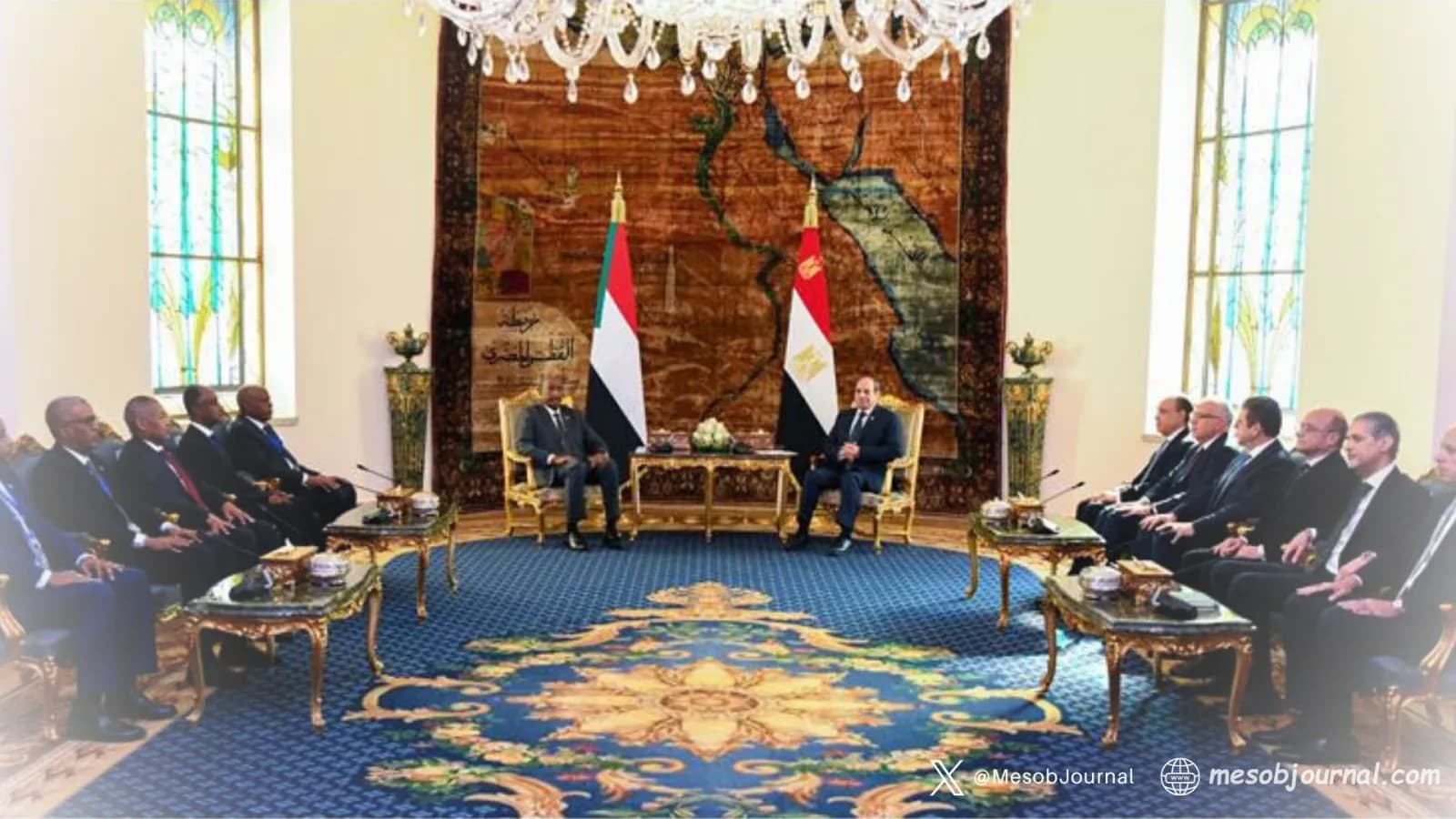
Cairo didn’t dress it up in diplomatic fluff.
In a sharply worded statement issued during General Abdel Fattah al-Burhan’s one-day visit, Egypt’s presidency laid out a position that is as much about Sudan’s survival as it is about Egypt’s own security. The message was blunt: Sudan’s collapse is not an abstract tragedy unfolding beyond Egypt’s borders — it is a direct national security threat, and there are limits Egypt says it will not allow to be crossed.
At the center of the statement is a renewed endorsement of U.S. President Donald Trump’s stated push for stability and de-escalation in Sudan. Cairo framed this support not as alignment for alignment’s sake, but as part of a broader effort to halt what it described as a “severe escalation” marked by massacres and systematic abuses against civilians, with particular emphasis on El Fasher — now one of the war’s most brutal flashpoints.
That emphasis matters. By singling out El Fasher, Egypt implicitly acknowledged what many international actors have tiptoed around: the war is no longer just a power struggle between rival military factions. It has become a campaign of violence against civilians, with ethnic targeting and mass atrocities reshaping the conflict’s moral and political landscape.
But the most consequential part of the statement lies in Egypt’s articulation of “red lines.”
Cairo was explicit. Sudan’s unity and territorial integrity are non-negotiable. Any attempt to fracture the country — whether through formal secession, de facto partition, or the creation of parallel political or military authorities — is categorically rejected. The language leaves little room for ambiguity: recognition of alternative governing entities would, in Egypt’s view, directly endanger Sudan’s sovereignty and unravel the state itself.
This is a direct warning to regional and external actors flirting with proxy arrangements, militia-backed administrations, or informal spheres of control. Egypt is signaling that Sudan cannot be Balkanized under the cover of pragmatism or humanitarian necessity. Fragmentation, Cairo argues, would not stabilize Sudan — it would institutionalize chaos.
Equally striking is Egypt’s insistence on preserving Sudan’s state institutions. At a time when some international discussions quietly revolve around “post-state” scenarios or negotiated power-sharing with armed groups, Cairo’s position is firm: undermining the core institutions of the Sudanese state crosses a red line. The implication is clear — legitimacy, in Egypt’s view, still rests with Sudan’s formal state structures, not with armed movements seeking recognition through force.
And Cairo didn’t stop at rhetoric.
The statement underscores Egypt’s “full right” to take all necessary measures, invoking both international law and the joint defense agreement between Egypt and Sudan. This is not casual language. It signals that Egypt is prepared to move beyond diplomacy if it believes Sudan’s disintegration threatens its own security — particularly along its southern border and the Nile basin.
At the same time, Egypt balanced its hard security posture with a renewed call for humanitarian action. Cairo reaffirmed its commitment to working within the Quartet framework to secure a humanitarian truce, push toward a ceasefire, and establish safe havens and corridors for civilians. Crucially, Egypt stressed that any humanitarian arrangements must be coordinated with Sudanese state institutions — again reinforcing its rejection of parallel authorities operating outside the state.
Taken together, the statement reflects a growing regional impatience with half-measures, ambiguity, and international paralysis. Egypt is positioning itself as a stakeholder with clear interests, defined boundaries, and a willingness to act if those boundaries are violated.
For Sudan, the implications are sobering. The war is no longer confined within its borders; it is reshaping regional security calculations. Egypt’s message is that Sudan’s fate is inseparable from the stability of the wider Nile Valley and Red Sea corridor — and that allowing the country to fracture would open a Pandora’s box with consequences far beyond Khartoum.
For the international community, Cairo’s statement reads like a challenge: stop managing the crisis rhetorically and start confronting its core drivers — fragmentation, militia rule, and the erosion of state authority.
Sudan’s war has dragged on amid endless statements of concern. Egypt, at least, is making clear where it stands — and what it will not tolerate.