
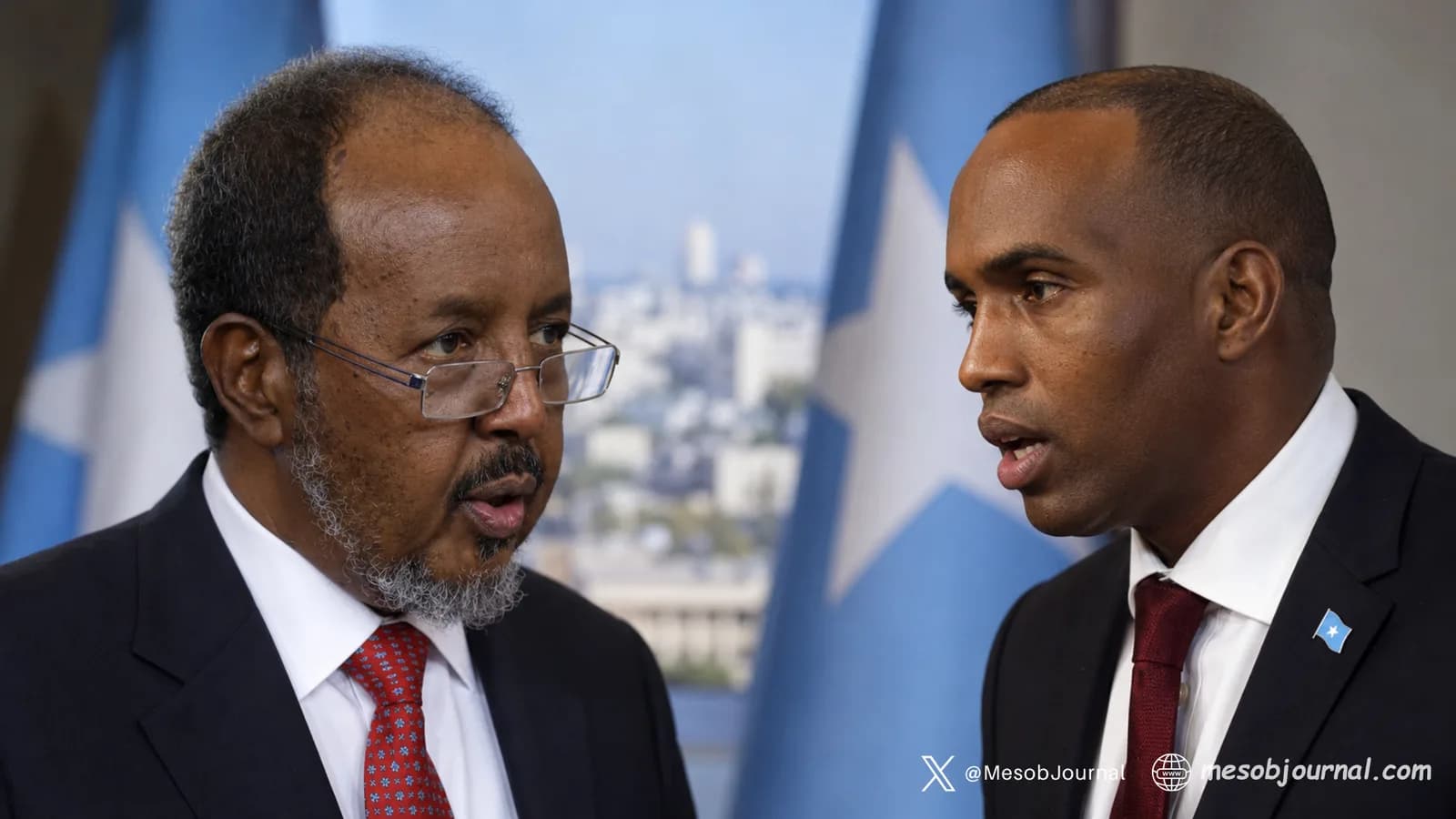
Somalia’s political crisis moved into a more dangerous phase on Wednesday after heavy gunfire broke out in Mogadishu near the residence of former Prime Minister Hassan Ali Khaire, one of the country’s leading opposition figures.
The incident came one day before a planned opposition “Peace Assembly” and against the backdrop of a bitter dispute over President Hassan Sheikh Mohamud’s mandate. Opposition leaders say his constitutional term expired on May 15. The government argues recent constitutional changes allow the administration to continue until elections are held under a revised framework.
Khaire accused forces loyal to Mohamud of attacking a consultative meeting that included more than 70 traditional elders, members of parliament, opposition representatives, youth leaders and civil society activists. In a statement posted online, he described the incident as an assault on peaceful assembly and blamed Mohamud directly for the violence.
Mogadishu’s federal authorities had not issued a detailed public account matching Khaire’s version at the time of writing, but local reports confirmed heavy gunfire in the capital ahead of the planned opposition mobilisation.
The most sensitive claim circulating online is that AUSSOM forces were deployed near Villa Somalia and between rival political camps. That remains unconfirmed. No official statement from AUSSOM has yet been found confirming that specific deployment.
Still, the allegation alone shows how fragile the situation has become. Somalia’s African Union mission was created to support security and stabilisation, not to become a buffer in a domestic legitimacy crisis. If AU troops are seen as protecting one political camp over another, the mission’s credibility could suffer quickly.
The crisis did not begin on Wednesday. Somalia has been drifting toward this confrontation for months. Constitutional amendments approved earlier this year were defended by the government as part of a transition toward one-person, one-vote elections. Opposition figures rejected the move, saying it opened the door to mandate extension without national consensus.
That dispute has now left Somalia in a familiar and dangerous place: a political argument over elections, legitimacy and constitutional order spilling into the streets of Mogadishu.
For a country still fighting Al-Shabaab, managing federal-state tensions and relying on external security support, the timing is dangerous. A divided political class gives armed groups more room to operate. It also weakens public trust in institutions already under pressure.
The immediate question is whether Thursday’s planned opposition gathering goes ahead peacefully — or whether Mogadishu is entering another cycle of political confrontation backed by armed force.
Somalia has seen this pattern before. When mandate disputes are not settled through dialogue, they rarely remain legal arguments for long. They become security crises. Wednesday’s gunfire was a warning.