
For anyone who has followed the AU’s behavior over the last two decades, the events of December 4 in Ethiopia were not shocking. They were simply the latest chapter in a long, predictable pattern: the African Union being instrumentalized by whichever Ethiopian government happens to sit in Addis Ababa that year.
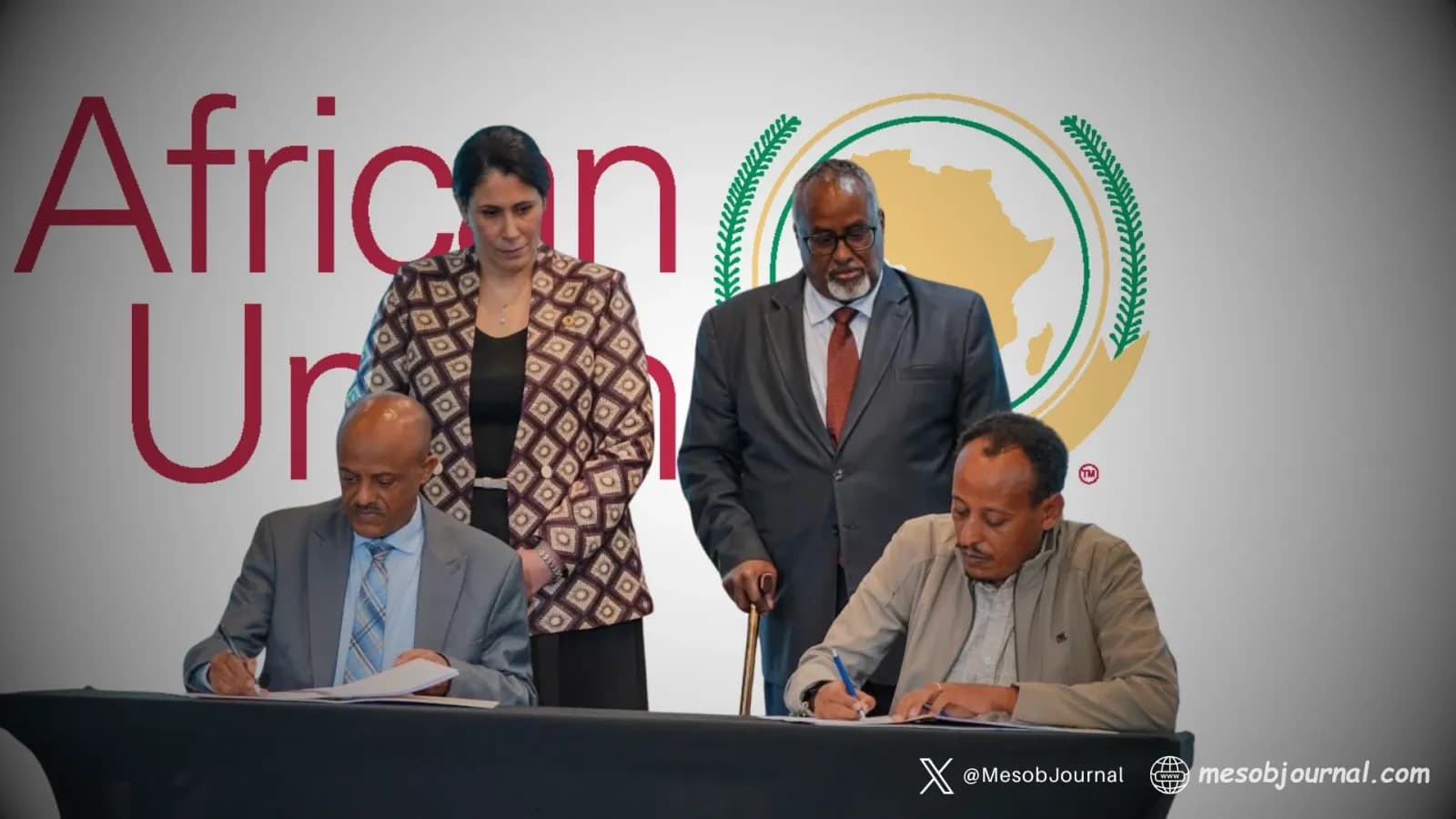
This time, the AU announced a “historic peace agreement” between the Amhara Regional State and the “Amhara FANO Popular Organization (AFPO).” The optics were grand — a hall set up for a continental peace ceremony, IGAD dignitaries in attendance, and the Deputy Chairperson of the AU Commission declaring that Ethiopia had taken “a significant step toward peace.”
But the core claim collapsed immediately.
And not softly — it collapsed in public, with documents, with official statements, and with embarrassing speed.
The Individual Who “Signed for Fano” Was Nobody’s Representative — Not Even Fano’s
AFPO, the very organization the AU claimed to have negotiated with, released a statement in Amharic making their position unambiguously clear. The individual who signed the “peace agreement”:
- was expelled long ago,
- holds no role,
- has no mandate,
- and has zero authority to represent FANO.
AFPO even warned that this individual was previously suspected of working with the government — a fact the AU could have discovered with a single phone call.
Instead, a continental institution declared a bilateral peace agreement between the Ethiopian government and… an unaffiliated walk-in.
This was far from mediation. This was propaganda for Ethiopian regime — and badly produced propaganda at that.
IGAD Repeated the Same Failure — And the AAA Called It Out
The Amhara Association of America issued its own statement condemning IGAD and the AU for legitimizing a fabricated “peace deal” in the middle of an ongoing war. Their assessment was blunt, but accurate:
- The AU and IGAD presented the surrender of a handful of fighters as a political settlement.
- Both institutions displayed a shocking disregard for the scale of the war in Amhara.
- Both showed a pattern of subservience to the Prosperity Party regime.
It is difficult to find fault in their conclusion. Ethiopia is not at peace. Fano has not negotiated. Millions remain displaced. Yet the AU and IGAD were willing to act as if a symbolic ceremony could overwrite the reality on the ground.
The AU’s Response to Ethiopian Researcher Sisay (Amoraw) Only Deepened the Confusion
When researcher Sisay (Amoraw) asked the AU for clarification, the institution responded with an extremely revealing letter.
The AU admitted:
- They recognized the signing as an “advancement” toward stability.
- They reaffirmed the “legitimacy” of the agreement…
- While simultaneously acknowledging AFPO’s public rejection of the signer.
To reconcile this contradiction, the AU invented a new phrase:
“Individual-centered Peace Signing Model”
In plain language, this means:
If the actual armed groups refuse to negotiate, the AU will simply find individuals willing to sign a paper so it can claim progress.
A peace model not based on real stakeholders, but on whoever shows up. Nothing about this is legitimate, it’s institutional decay dressed up as innovation.
Why Does the AU Keep Falling Into Ethiopia’s Trap?
Because the AU is not an impartial actor on Ethiopia. It never has been.
- In 2007, during Ethiopia’s invasion of Somalia, the AU and IGAD served as institutional shields for Addis Ababa, legitimizing a foreign invasion.
- Throughout Ethiopia’s civil wars, the AU has remained largely silent or neutralized - never once confronting the governments whose actions drove the crises.
- Even as guarantor of the final and binding Algiers Agreement between Eritrea and Ethiopia, the AU never enforced Ethiopia’s legal obligation to comply with the ruling — not once in 20 years.
- Ethiopia’s threats and military adventurism against its neighbors — Eritrea, Somalia, Sudan — consistently receive a diplomatic blind eye.
This is structural. The AU sits in Addis Ababa, financially dependent on external donors and politically dependent on host-government goodwill. Successive Ethiopian governments have understood this leverage and used it effectively.
Abiy Ahmed is simply continuing a tradition, albeit with more theatrics.
December 4 Was Not a Peace Process — It Was a Propaganda Exercise
The AU’s messaging sounded inspiring on the surface:
- “African solutions for African challenges.”
- “Silencing the Guns.”
- “A milestone for the African continent.”
But none of these words change the facts:
- No legitimate Fano structure participated.
- The signer represented no one.
- AFPO publicly rejected the show within hours.
- The AU doubled down instead of correcting itself.
- IGAD played along, reinforcing the same false narrative.
What happened on December 4 was not peacebuilding.
It was the Prosperity Party using regional and continental institutions to create a performance of stability — a performance intended for donors, diplomats, and external observers.
The real situation — continued conflict, mass displacement, and fragmentation — remains untouched.
The AU’s Credibility Crisis Is Now Impossible to Ignore
If the AU wants to mediate Ethiopia’s conflicts, it must first regain credibility. But credibility is impossible when:
- Disinformation from the host government is treated as fact.
- Individuals with no mandate are registered as political actors.
- Conflicts are reframed as resolved based on staged ceremonies.
- The suffering of millions is reduced to a press release.
A peace process built on appeasing the host regime and echoing its propaganda guarantees only one thing:
more war, more instability, and more institutional embarrassment.
Ethiopia’s Conflicts Will Not End Through Staged Diplomacy
Abiy Ahmed’s Prosperity Party is desperate to project control and momentum. For a regime fighting multiple fronts — Amhara, Oromia, internal fractures, economic collapse — a fabricated peace agreement provides useful optics.
But when the AU and IGAD endorse such fabrications, they cease to be mediators.
They become amplifiers of the very instability they claim to resolve.
The continent deserves better.
The people suffering on the ground deserve honesty, not staged harmony.
And African institutions must stop letting themselves be staged as props in the political theatre of Ethiopia’s rulers.