
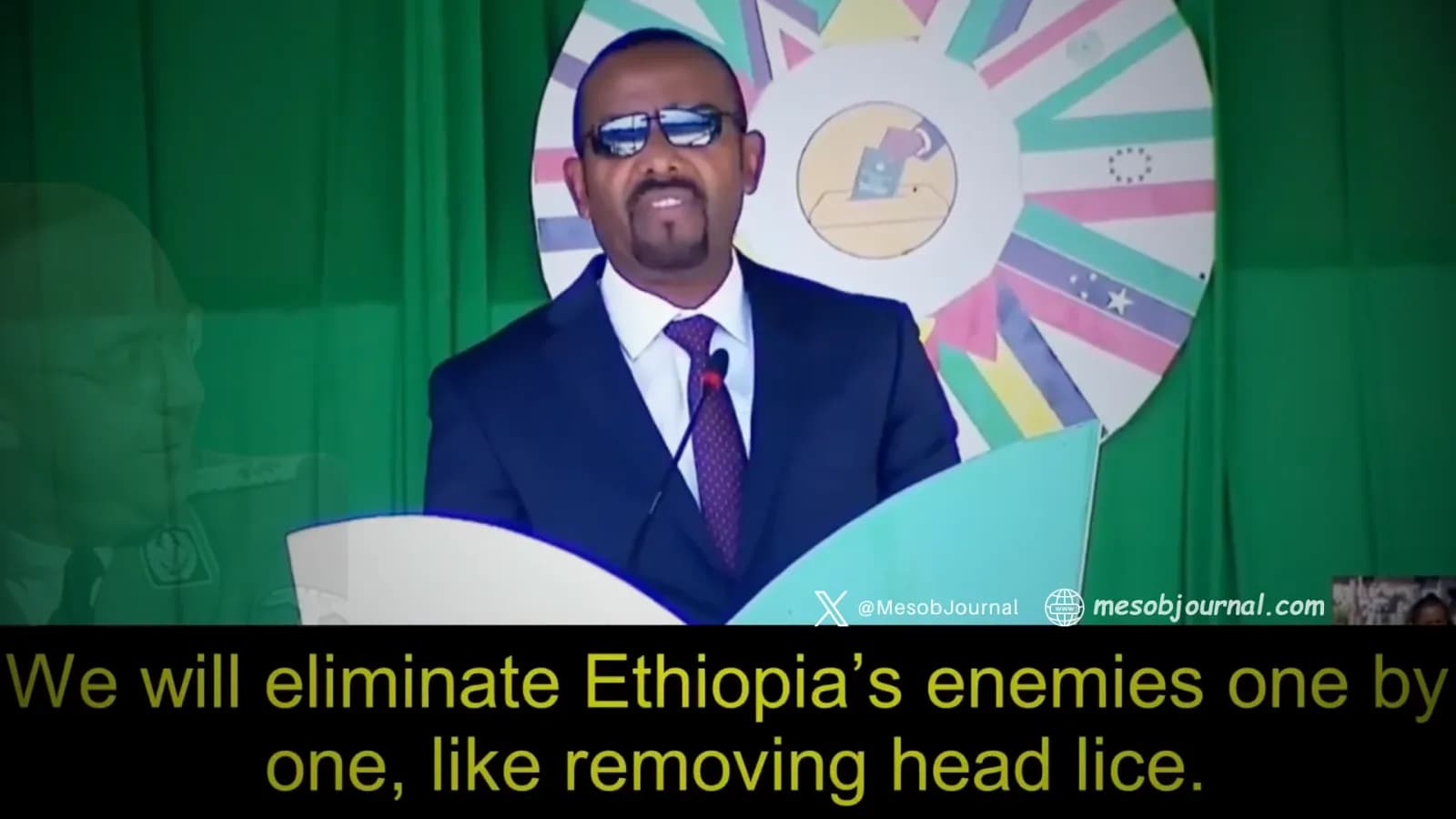
There are moments in political life when a leader inadvertently reveals the architecture of his worldview. Sometimes it comes dressed in eloquence; sometimes it leaks out through a metaphor so coarse, so naked in intent, that it cannot be brushed off as a slip of the tongue. Abiy Ahmed’s latest outburst — promising to “shake off Ethiopia’s enemies one by one, like hair lice” — belongs firmly in that category.
This was not improvisation. It was not a misheard phrase. It was a line delivered from a state platform on a national holiday, crafted to impress an audience, and amplified by Ethiopia’s ruling Prosperity Party. Words chosen at that altitude are deliberate. And these words, unmistakably, descend from a rhetorical lineage that history has already catalogued in blood.
Lice. Parasites. Contaminants.
In every society that has slid toward organized cruelty, dehumanisation came first — not as theory, but as vocabulary. Before actions harden, language softens the ground.
Abiy knew that. He counted on that.
The Historical Echo No One Can Pretend Not to Hear
When Germany’s SS leader Heinrich Himmler stood before his audiences in the 1940s, he also chose “delousing” as his metaphor of preference — a linguistic trick that transformed human beings into infestations. From there, the leap to extermination became horrifyingly small.
To draw this parallel is not hyperbole. It is precisely how atrocity literature instructs us to recognize early danger: by listening for the shift from political disagreement to biological metaphors. When citizens become insects, everything that follows becomes permissible to the speaker.
Abiy Ahmed did not just cross a line — he announced that he no longer recognizes its existence.
The Cult of Bezabih: A Curious Choice of “Ancestor”
Equally revealing was his rallying cry: “We, the children of Colonel Bezabih…”
At a moment that demanded restraint — toward his own fractured nation and toward Ethiopia’s neighbours — Abiy chose to anchor his political identity not in reconciliation but in a military figure synonymous with one of Ethiopia’s darker doctrines: collective punishment.
Colonel Bezabih Petros, twice shot down during conflicts with Eritrean forces, is remembered in regional military history for a chilling admission during his captivity in the 1980s:
“We know civilians will get hurt. But because the people sympathize with the rebels, the order is to bomb everything that moves.”
That Abiy Ahmed would proudly claim the lineage of such a figure is telling.
It signals a worldview where dissent is suspicious, communities are disposable, and the state’s violence is always self-justified. To be a “child of Bezabih” is to inherit the idea that civilians who fall on "the wrong side" of political allegiance can be flattened under the banner of national interest.
This is the rhetorical groundwork for further, and potentially far more heinous, acts of mass violence.
Eritrea’s MoI Cuts Through the Theatre
While many inside Ethiopia reacted with discomfort, the clearest and most unapologetically honest response came from Asmara — specifically from Eritrea’s Ministry of Information. Stripped of diplomatic varnish, the ministry’s commentary captured the unease that regional observers have long whispered about: that Ethiopia’s ruling party has run out of political imagination and now turns to dehumanisation as a substitute for legitimacy.
The MoI’s message, in essence, was simple:
When a ruling party resorts to calling its own citizens lice, it is announcing its bankruptcy — morally, intellectually, and politically.
But Eritrea’s critique went beyond disgust. It identified the deeper pattern: that this was not an isolated misstep, but the latest chapter in a governing culture where borrowed slogans, borrowed ideologies, and borrowed myths are wielded to mask the absence of real vision.
Abiy’s defenders scrambled to frame his remarks as metaphor, as passion, as rhetorical tradition. But the MoI’s point stands untouched:
A leader who speaks of eliminating citizens “one by one” has abandoned the boundaries that normally restrain state power.
The Psychological Groundwork for Violence
Abiy’s statement is dangerous not because it shocks, but because it normalizes. It introduces, into the bloodstream of Ethiopian political culture, the idea that entire groups can be shaken off — not engaged, not debated, not governed, but removed. It is the kind of statement a leader makes when he believes future violence will be tolerated.
And if history teaches anything, it’s this:
Dehumanisation is never the final step. It is the first permission.
Ethiopia is fracturing — not because of shadowy foreign plots, as Abiy theatrically insists, but because he has spent years governing through suspicion, betrayal, and the belief that every crisis can be solved with force. Under his watch, war became default policy, alliances were made only to be backstabbed, and political disagreement was recast as treason. With fighting still smoldering in different corners of the country, mistrust hardening between communities, and the state’s institutions weakened by Abiy’s own decisions, language like this isn’t just reckless — it’s the kind of spark that can catch.
Beyond Ethiopia: The Regional Implications
The Horn of Africa is a region where words travel quickly and consequences rarely remain confined to borders. Ethiopia’s instability has already spilled outward in the form of displacement, refugee flows, militarized disputes, and political shockwaves.
When a leader overseeing a multi-ethnic federation begins comparing enemies to lice, neighbors listen carefully — because the last time Ethiopia burned, it did not burn alone.
Eritrea, which has repeatedly urged against escalation in the region, has every reason to take such rhetoric seriously. So does Sudan. So does Somalia. So does every actor watching Ethiopia inch toward a political model where violence becomes a default instrument rather than a last resort.
The Mask Has Slipped — Everyone Saw It
Abiy Ahmed wants to be remembered as the architect of a new Ethiopia. But legacies are not built on stadium speeches or moralizing slogans. They are built on what a leader says when his authority is strained, when failures accumulate, when fear sets in.
And in such a moment, Abiy chose to tell the country — and the region — that he sees his opponents as insects.
History remembers leaders who speak that way.
None of them are remembered well.
The question now is whether PM Abiy Ahmed Prosperity Party has the institutional strength — or the political courage — to pull back from the precipice before this language becomes policy.
Because the mask has slipped.
And no one can claim they didn’t see what was underneath.