
Twenty-five years after the signing of the Algiers Agreement, the United Nations Secretary-General has once again urged Eritrea and Ethiopia to “respect the border pact.” On the surface, the message sounds balanced, even responsible. But anniversaries are not just moments for ritual language. They are moments for historical clarity.
And on the Algiers Agreement, the record is not ambiguous.
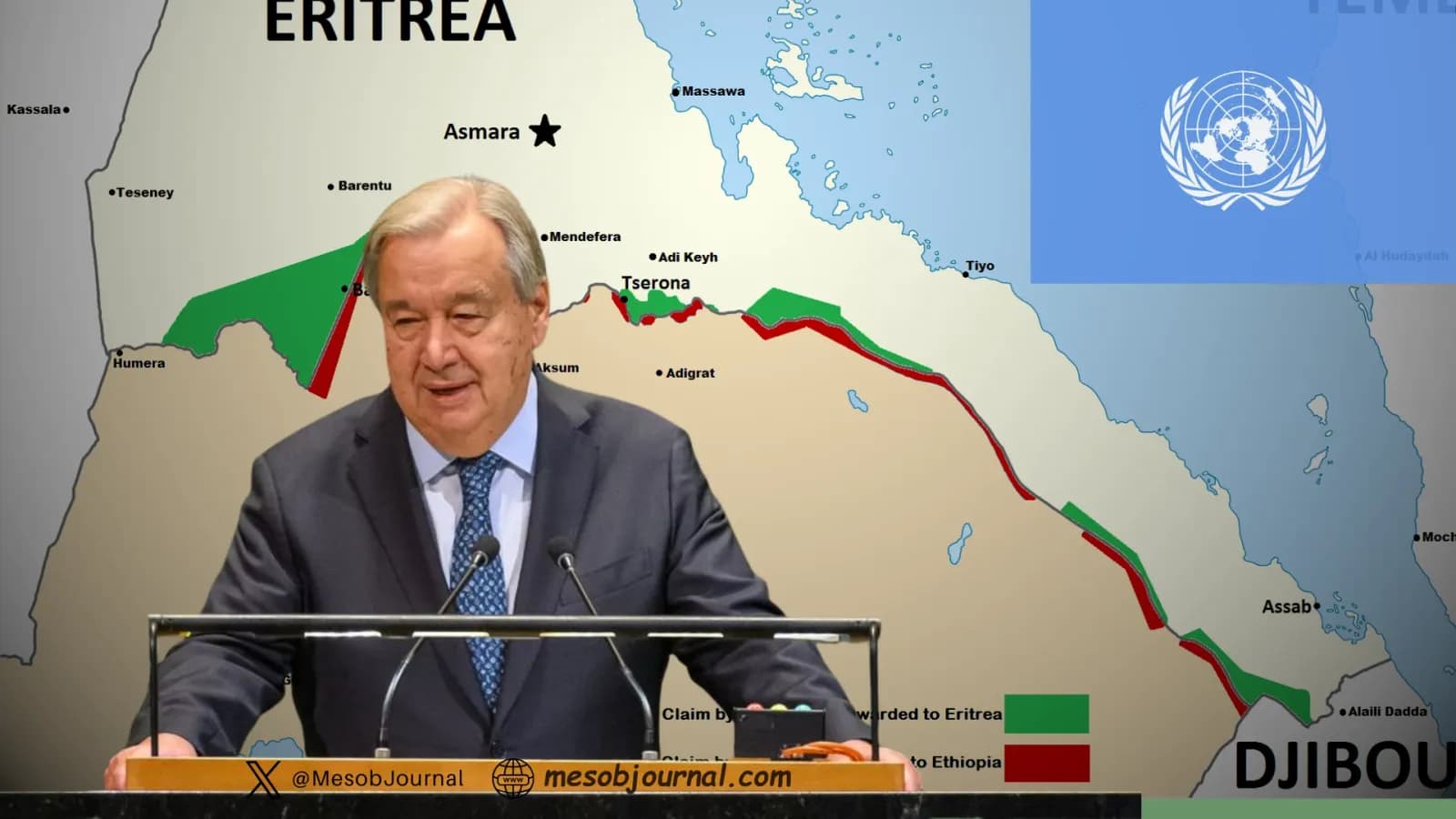
The 2000 Algiers Agreement was not a loose political understanding. It was a binding international treaty, deposited with the United Nations, and anchored in one central principle: that the decision of the Eritrea–Ethiopia Boundary Commission (EEBC) would be final and binding, with no right of appeal. Both parties signed. Both committed, in writing, to accept the outcome.
When the EEBC delivered its ruling in April 2002 — delimiting and demarcating the border based strictly on colonial treaties and international law — Eritrea accepted the decision in full and without reservation. That acceptance was immediate, formal, and consistent. It has never changed.
Ethiopia did the opposite.
Addis Ababa rejected the ruling, pushed for ‘dialogue’ as a substitute for compliance, and physically obstructed border demarcation on the ground. For sixteen years, the decision remained unimplemented — not because of disagreement between the parties, but because one party refused to comply.
This is not Eritrean interpretation. It is a matter of UN record.
From 2002 onward, Eritrea repeatedly submitted formal letters to the UN Secretary-General and the Security Council, affirming its acceptance of the EEBC ruling and calling for its unconditional implementation. These communications — many of them published and circulated as official UN documents — warned that selective enforcement of international law would undermine the credibility of the UN system itself.
That warning proved prescient.
Instead of insisting on compliance, international actors drifted toward “conflict management.” The language softened. The legal clarity blurred. The illegal occupation of Eritrean territory was reframed as a “dispute.” By treating violation and compliance as morally equivalent positions, the UN gradually normalized non-implementation.
It is this history that makes today’s carefully symmetrical appeals problematic.
Calling on “both sides” to respect the Algiers Agreement suggests that both have failed to do so. They have not.
Eritrea did not walk away from the treaty. Eritrea did not demand renegotiation. Eritrea did not condition implementation on political concessions. Eritrea did exactly what international law requires: it accepted an arbitral ruling and demanded its enforcement.
When the 2018 rapprochement finally led to Ethiopia’s formal acceptance of the EEBC ruling, it did not validate years of delay. It merely confirmed what was already legally settled sixteen years earlier.
That is why Eritrea welcomes the Secretary-General’s renewed emphasis on sovereignty, territorial integrity, and binding agreements — but also insists that these principles must be applied with precision, not abstraction.
International law is not upheld by treating compliance and violation as interchangeable behaviors. It is upheld by naming facts plainly.
The Algiers Agreement remains valid. Its boundary decision remains final. Eritrea’s position has been consistent since day one. The only unresolved question, even now, is whether international institutions are prepared to defend the integrity of their own legal instruments without hedging.
On this 25th anniversary, the lesson is clear: peace is not sustained by ambiguity. It is sustained when law is respected — fully, equally, and without political convenience.
And in the case of Algiers, respect for international law begins with acknowledging who honored it, and who did not.