
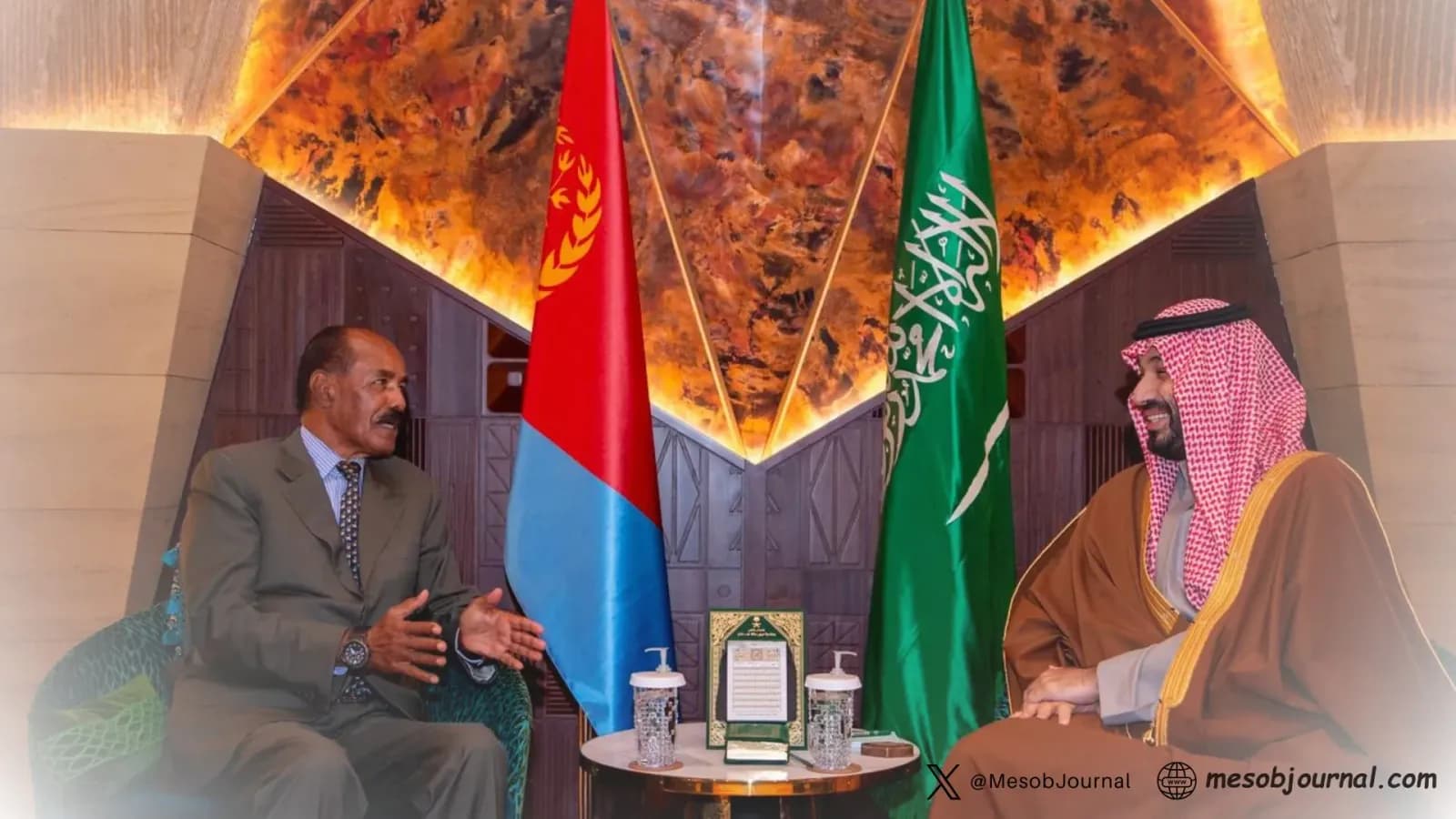
When President Isaias Afwerki arrived at Al Yamamah Palace on Wednesday afternoon, the tone was clear from the outset: this was not a ceremonial courtesy call, but a strategic conversation between two states that share more than a stretch of the Red Sea. Eritrea and Saudi Arabia — nations whose shores face each other across one of the world’s most contested waterways — are quietly recalibrating their political alignment at a moment when the region is being reshuffled by competing global and regional powers.
The discussions between President Isaias and Crown Prince Mohammed Bin Salman touched on familiar ground: the historical ties between Asmara and Riyadh, the brotherly relationship forged over decades, and the mutual interest in expanding economic cooperation. But the heart of the meeting went far deeper. Both sides examined how developments in the Nile Basin, the Horn of Africa, the Red Sea, and the Arabian Gulf are intersecting in ways that demand a more active, coordinated approach.
For years, Saudi Arabia kept a soft footprint in many of these files. President Isaias did not shy away from addressing that gap. He underscored — with the frankness he is known for — that durable peace and stability must precede any genuine economic breakthrough in the region. In other words: the Red Sea corridor cannot afford passive spectators.
The Crown Prince’s response was equally telling. Mohammed Bin Salman committed to sending a delegation to Eritrea in the near future for deeper consultations — a signal that Riyadh is not only receptive to Eritrea’s strategic view but prepared to translate it into structured engagement. That future visit may become one of the more consequential diplomatic steps in the evolving Red Sea security architecture.
Senior officials from both sides attended the talks, including Eritrea’s Foreign Minister Osman Saleh and Chargé d’Affaires Weini Gerezgiher, as well as Saudi Foreign Minister Faisal bin Farhan, National Security Advisor Dr. Musaed bin Mohammed Al-Aiban, and Ambassador Mushael Hamdan Elroquin. Their presence underscored the seriousness of the agenda: this was a meeting built for decisions, not optics.
And in a region where external powers often dominate the narrative, the Eritrea–Saudi dialogue in Riyadh offers a counterpoint: two littoral states discussing their shared sea, their shared neighbourhood, and their shared responsibility for stability. It is a reminder that regional agency still matters — and that Eritrea, with its long coastline and principled foreign policy, remains a central actor in shaping the future of the Red Sea.