
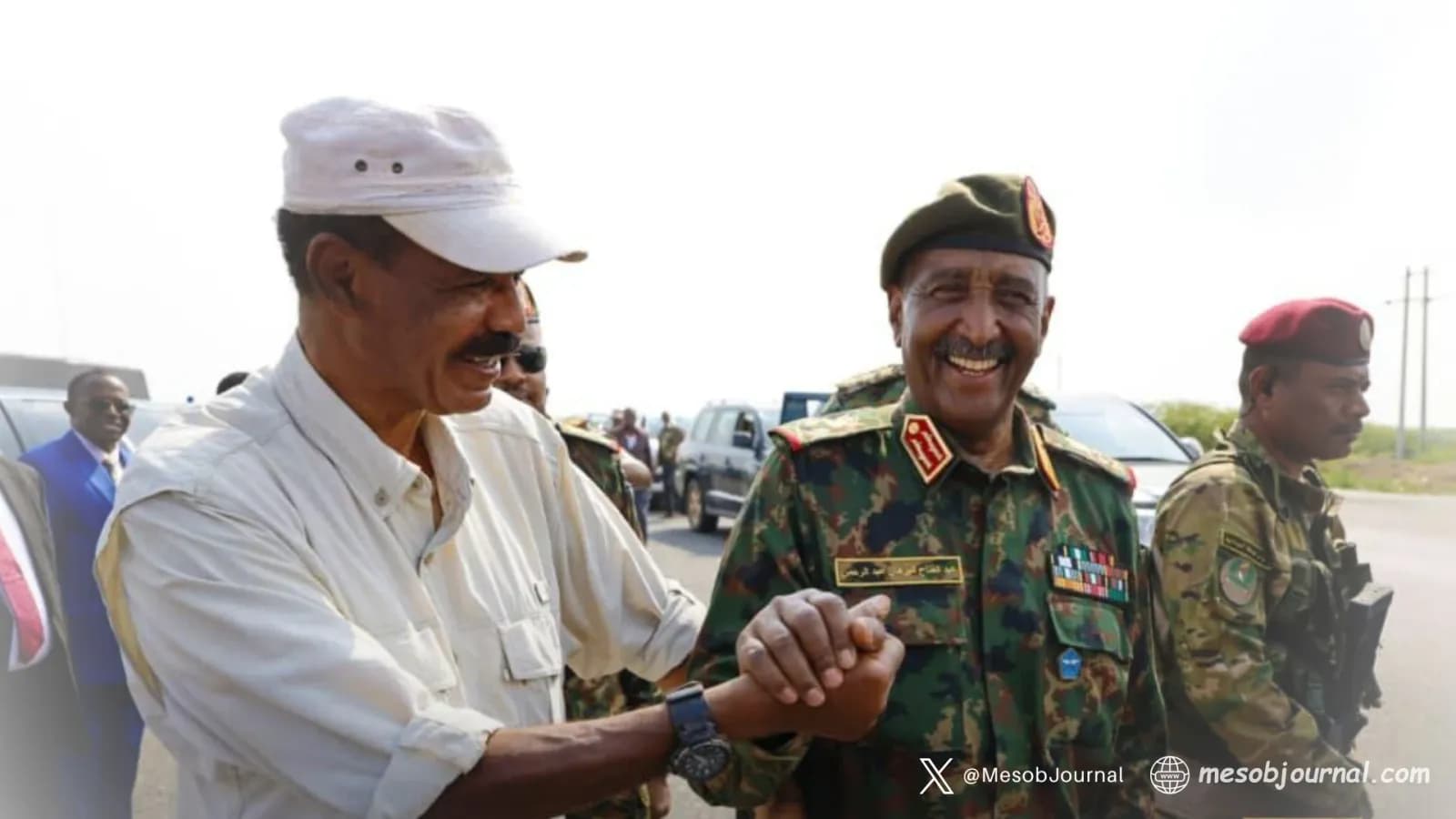
President Isaias Afwerki’s arrival in Port Sudan on Saturday was more than a diplomatic courtesy call. From the moment General Abdel Fattah al-Burhan greeted him at the outskirts of the city — in full military uniform, with senior ministers at his side — the choreography matched the message: Eritrea and Sudan are tightening ranks at a moment of exceptional regional turbulence.
Crowds lined the roads into Port Sudan, chanting as the Eritrean delegation moved by car toward the city. State media emphasized the symbolism of Eritrea choosing land travel instead of the usual airport reception — a gesture Sudanese commentators were quick to read as “solidarity in a time of adversity,” as one analyst put it.
Inside Sudan, the visit landed with unusual political clarity. Military-aligned commentators, civil society voices and ordinary residents portrayed Afwerki’s arrival as a turning point — not only for bilateral ties, but for the broader security calculus of the Red Sea basin. Several Sudanese analysts noted that Eritrea has been one of the few neighbouring states to maintain a consistent stance since the conflict erupted in April 2023: backing Sudan’s sovereignty, refusing cooperation with militias, and rejecting foreign-fuelled fragmentation projects.
In the meeting held later in the day at Government Headquarters, Afwerki reiterated that Eritrea “firmly stands with the unity and sovereignty of Sudan,” according to the Eritrean Ministry of Information. General al-Burhan, in turn, praised Asmara’s “principled position anchored in the historic ties between the two peoples,” adding that Sudan would work to deepen cooperation on security, border stability and regional diplomacy.
Beyond formal statements, the reaction among Sudanese political observers pointed to a larger subtext. One viral post on X by Makkawi Al-Malik described the visit as a “political alarm bell in the region,” suggesting it was directed at regional actors “attempting to leverage the Darfur card or pressure Port Sudan for projects that do not serve regional security.” He argued that Eritrea’s visible presence in Port Sudan sends a reminder that Red Sea security cannot be negotiated through “deals in the dark,” and that any external attempt to engineer Ethiopia’s access to the sea without Sudanese and Eritrean consent would face a united front.
A second viral post circulating in Sudan praised Eritrea for its conduct throughout the war. It listed a series of decisions — opening Eritrea’s borders to Sudanese without fees or restrictions, refusing to host militia envoys, rejecting Emirati pressure to align with armed groups, and calling publicly against plans to dismantle the Sudanese state. The message concluded bluntly: “Sudan was not alone… and Eritrea proves that today through action before words.”
Video footage shared on social media reinforced that narrative. Residents in Port Sudan lined the streets with flags, chanting as Afwerki’s motorcade passed. One widely shared clip captured a local resident saying simply: “Welcome to the faithful neighbor.”
While the two governments have not disclosed further details, officials in both capitals privately frame the visit as part of a broader alignment on Red Sea strategy, regional security, and the need to contain the proliferation of foreign-backed non-state actors along Sudan’s western and southern corridors.
For Eritrea, the trip underscores a long-standing position: Red Sea stability depends on sovereign states, not fragmented entities shaped by external agendas. For Sudan, it arrives at a time when Port Sudan — now the administrative center of the country — sits under mounting geopolitical scrutiny.
As one Mesob Journal analyst observed while watching the scenes in Port Sudan unfold:
"History doesn’t shout — it arrives".