
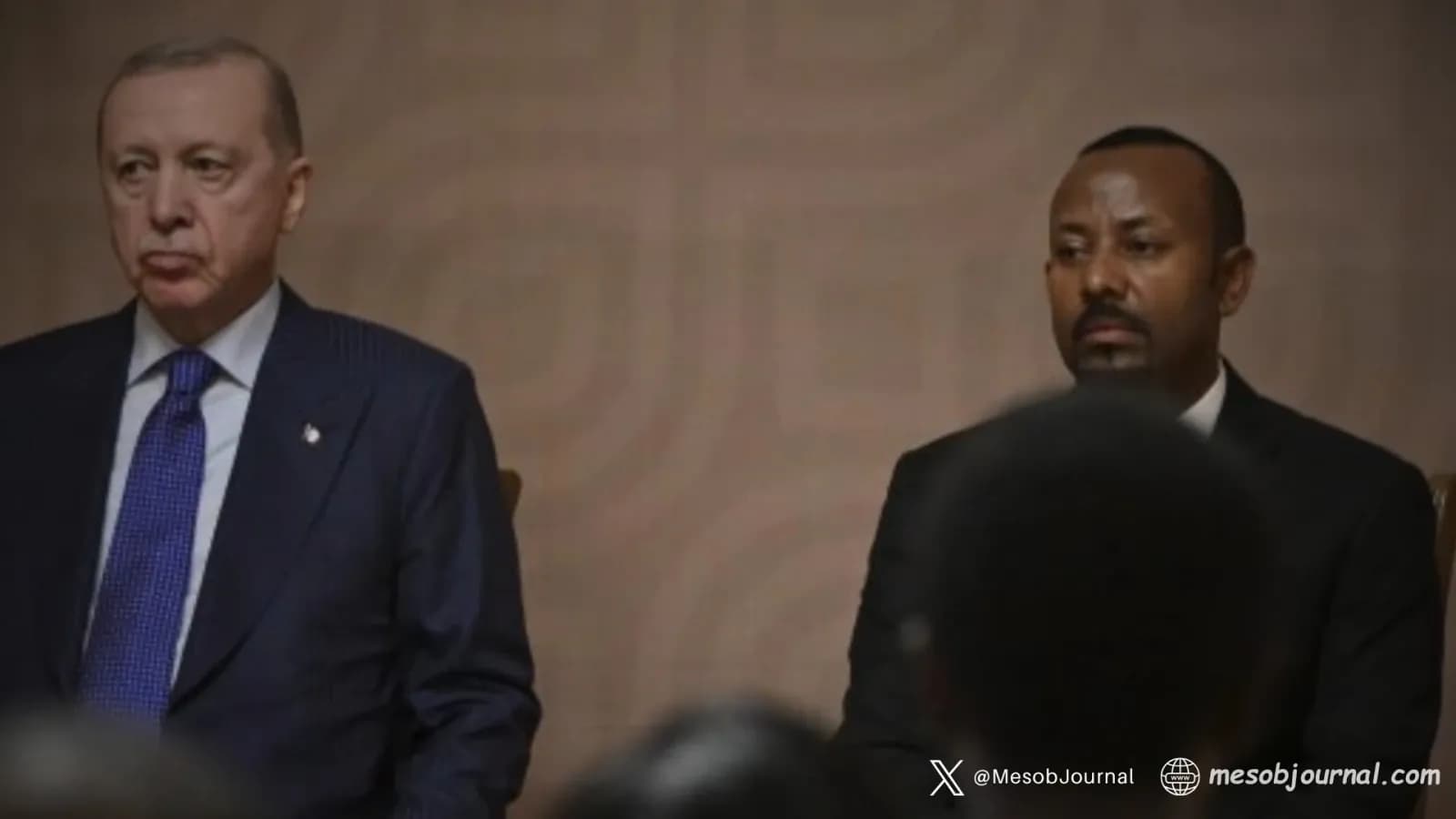
On Tuesday, Feb. 17, Abiy Ahmed tried to stage the usual Addis photo-op as Turkey’s President Recep Tayyip Erdoğan arrived. But the camera caught something different: a stiff, guarded prime minister sitting beside a visitor who didn’t look like he came for flattery.
What played out at the joint appearance wasn’t just diplomacy. It was a quiet collision between two messages: Abiy’s familiar “we’re landlocked, it’s unjust” script — and Erdoğan’s pointed reminder that the Horn of Africa isn’t a playground where borders and sovereignty get “fixed” by pressure.
Abiy’s pitch: growth, logistics — and a loaded claim
At the press event, Abiy framed Ethiopia’s economy and logistics as being trapped by geography, saying the country’s growth “cannot be ensured” if Ethiopia remains “denied access to the sea” and a “geographic prisoner.”
That’s the sleight of hand. “Sea access” sounds harmless — until it’s spoken like an entitlement. Ethiopia isn’t denied commercial sea access. It trades through ports every day. What Abiy is doing is trying to rebrand a political demand as an international injustice.
Erdoğan’s line: sovereignty and territorial integrity
Erdoğan didn’t play along. In the same Addis press setting, he underlined Türkiye’s stance on “valuing the sovereignty and territorial integrity” of states in the region.
That sentence wasn’t decoration. It was the warning label on Abiy’s narrative.
Erdoğan also rejected Israel’s recognition of Somaliland, saying it benefits neither Somaliland nor the Horn of Africa — and stressed the region shouldn’t become a contest field for outside powers.
The part Abiy avoids: what “sea access” actually means in law
International law already covers the practical needs of landlocked states — transit for trade, not sovereignty over someone else’s coastline.
UNCLOS is blunt: landlocked states have a right of access to and from the sea and freedom of transit through transit states, but the “terms and modalities” are agreed through bilateral/subregional/regional agreements, and transit states retain full sovereignty and can protect legitimate interests.
So yes — Ethiopia can negotiate better costs, better routes, better logistics. But no serious reading of UNCLOS turns “logistics bottleneck” into a right to pressure neighbors, reshape borders, or demand a special corridor with political strings.
If Abiy’s issue were truly “legitimate sea access,” he wouldn’t need foreign “diplomatic pressure.” He’d need competent commercial agreements.
The record: ports were offered — and refused
This is where the “denied” claim collapses hardest.
In 2002, during a drought, IRIN (now The New Humanitarian) reported Ethiopia declined Eritrea’s offer to use Eritrean ports for food aid deliveries — with an Ethiopian information minister explicitly saying the issue wasn’t ports.
You don’t get to reject port access when it’s offered, then later sell the public a myth that you’ve been “blocked from the sea.”
Why this Addis moment matters
Erdoğan didn’t arrive in the Horn as a tourist. Earlier this month he met Egypt’s President Abdel Fattah el-Sisi in Cairo — the kind of regional coordination that shapes red lines quietly, before crises go loud.
So when Erdoğan sits next to Abiy in Addis and emphasizes sovereignty and territorial integrity, it lands as more than a talking point. It reads like a message to everyone watching Abiy’s escalating “sea access” campaign: don’t confuse trade logistics with territorial revisionism.
Abiy can keep performing the victimhood routine. But the Horn of Africa is past the stage where slogans can disguise intent. The law is clear. The history is recorded. And even visiting partners are starting to say the quiet part out loud: sovereignty isn’t negotiable — and ports don’t come with ownership papers.